
What is in the first report?
Dated photos, a marked drawing and a score for every item, with cores and moisture readings added when the roof calls for them.
Commercial roofing in Caledonia, WI for WIS 32 corridor buildings and lakeside communities, with dated photo sets, moisture surveys and rated condition reports.
A downspout that dumps onto the membrane instead of past the wall is a small finding, and on a commercial building in Caledonia, WI it is exactly the sort of thing a facility director can photograph, date and file. The photograph, the plan location and a note on the staining below create a record that shows whether the problem is new or old, and whether it has been fixed.
WIS 32 runs through Caledonia, a village in Racine County that includes the communities of Franksville, Husher and the lakeside Tabor, and it borders Oak Creek in the Milwaukee metropolitan area. A village with a highway corridor and a lakeside edge has commercial roofs of different ages, and each needs a plain, current file.
We work from the drains outward, probe the seams, rate each finding and write it down so a later reader can see what changed.
The first walk takes as long as the roof requires, and the report follows in writing, with every finding dated and located on the plan.
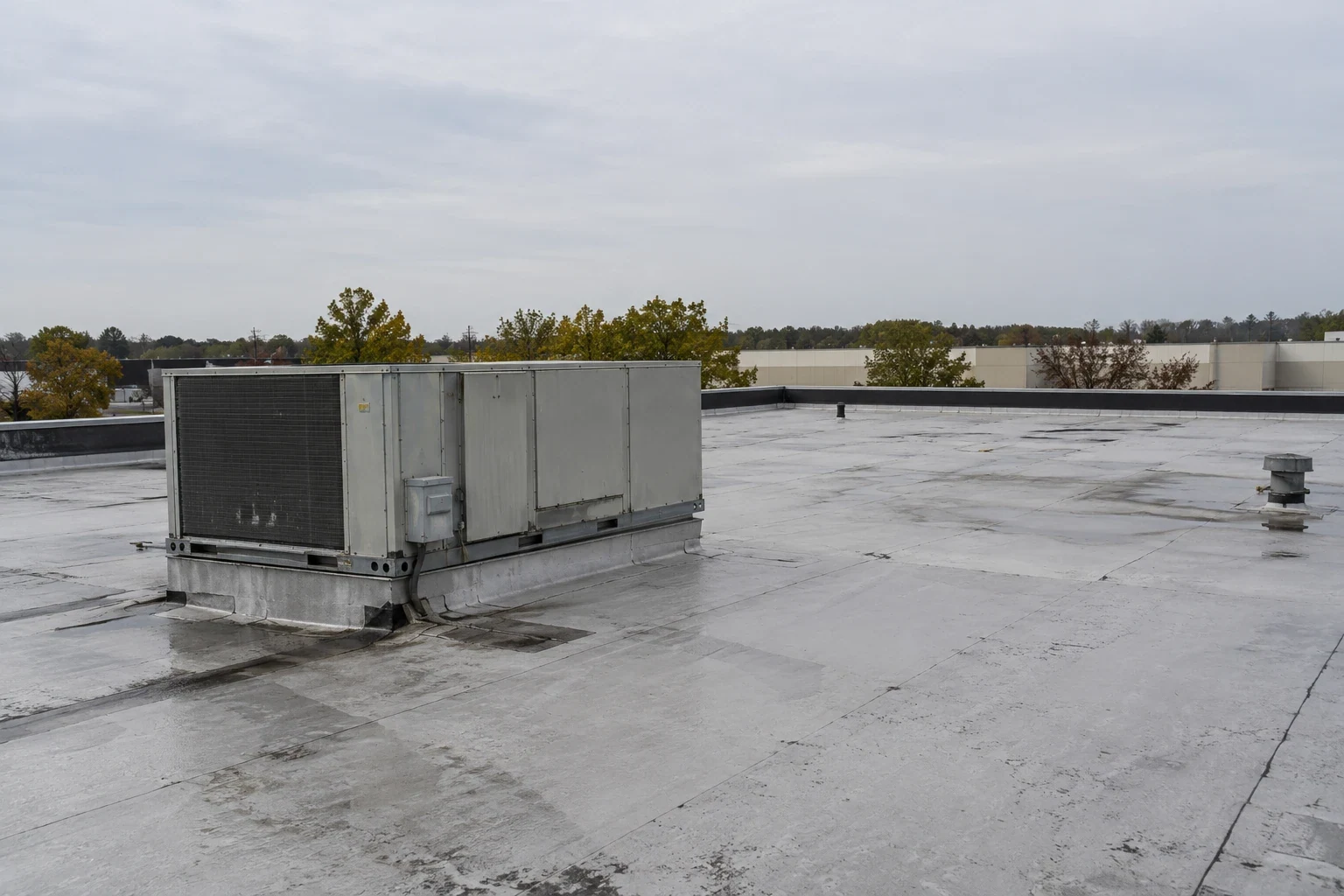
Commercial buildings along WIS 32 are typically inspected the same way: drains first, then seams and flashings, then equipment. Each rooftop unit gets a curb check, and each penetration gets a photograph and a rating. A sealant bead that has crazed but still adheres is rated as monitor; one that has pulled away is rated for repair.
On a multi-tenant roof we map each unit to its piece of roof, so a leak call leads to a known spot. The plan marks each drain, each curb and each hatch, and the log ties every finding to a location.
Parapet walls and counterflashing are checked from the roof side. Termination bars, sealant joints and mortar joints are probed, because wall details are a frequent leak path on low-slope roofs.
If the walk finds a pattern, such as repeated failures at the same type of detail, the report says so. That lets the owner fix the cause rather than the symptom.
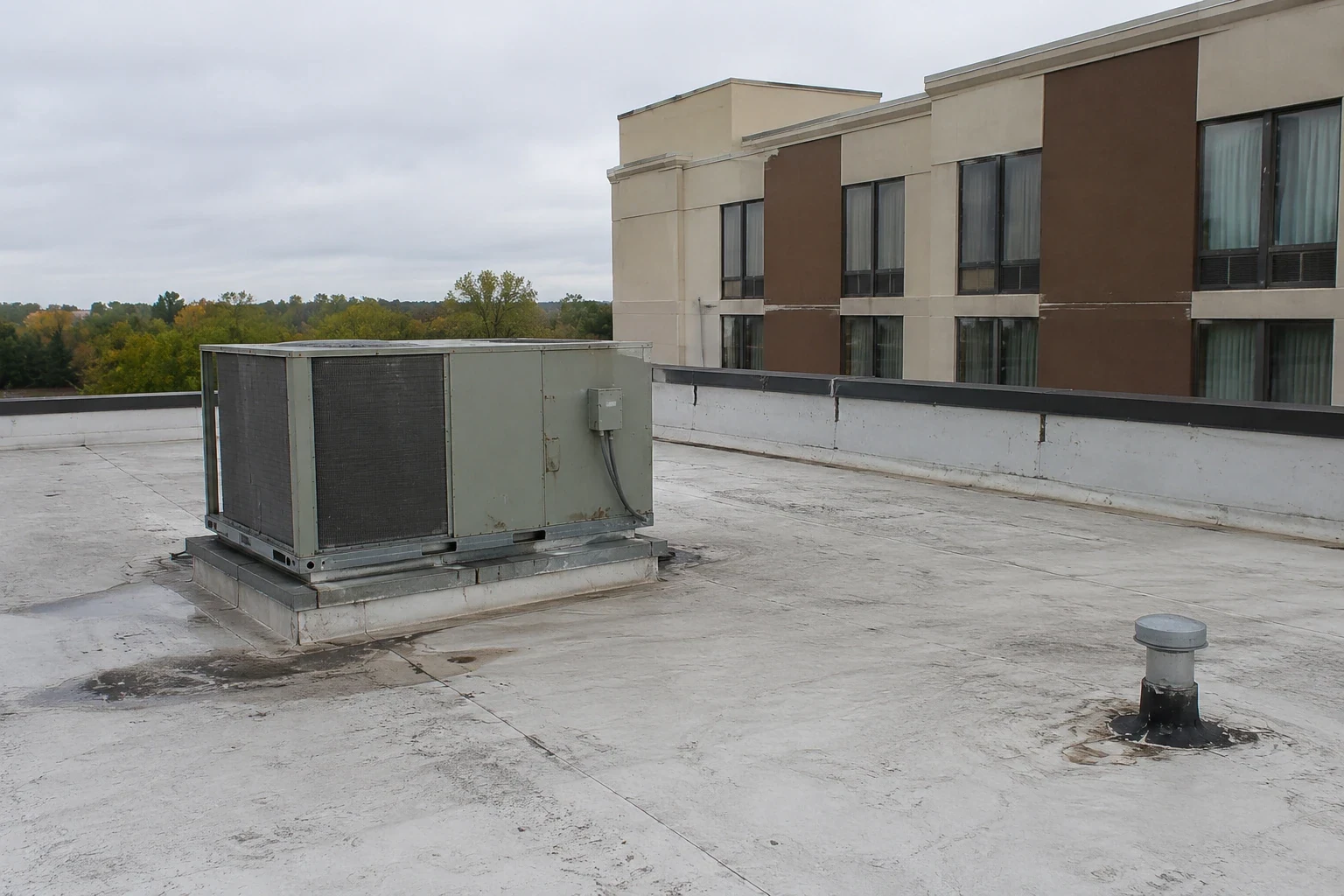
Tenants along a commercial corridor change equipment. A tenant swaps a unit, a vent is rerouted or a duct is added, and each change leaves a penetration. We compare the roof with the last plan, log what is new and check the flashing around it. A penetration without a proper base flashing is rated for repair before the next freeze.
Drains deserve their own pass. We flush each one, time how quickly water leaves and look for baskets and strainers that are missing or buried. A slow drain is a work order, and the photograph of the clogged strainer goes in the file. For ponding that remains after a rain, the ponding water repair options depend on whether the cause is slope, deck movement or a blocked outlet.
Tabor is the lakeside community in Caledonia, and a building near Lake Michigan is read with the lake in mind. The lake also affects the county to the south, where Kenosha’s shoreline subjects lakefront buildings to wind and freeze-thaw. Edges, coping and flashings take the wind, and water entering a joint freezes and widens it.
On a lakeside roof the perimeter is logged first. The coping is examined joint by joint, with fasteners and sealant checked and a ruler placed beside gaps for the photo. When coping has come up, an edge metal repair is priced and booked, with the before photo kept.
Wind-driven rain gets a second check at walls. Counterflashing and sealant are probed from the roof, and any gap is rated, since sideways rain finds gaps that gravity-fed rain does not.
The same inspection applies in Franksville and Husher. The ratings do not change with distance from the water, but the order of the walk does: wind edges first on a roof near the lake, drains first on a roof farther from it.
Roof-mounted equipment near the lake gets a fastener check as well. Wind loosens unit hold-downs, screens and signage supports over time, and the log notes any that are loose, corroded or missing.
Nearby Racine gets around 41 inches of snow and 36.98 inches of precipitation a year, and its January daily high averages 29.6 degrees. Winter piles real weight on a Caledonia roof, and it lands on low spots, parapet pockets and the sheltered side of rooftop units.
Each spring we log the marks winter leaves: cracked sealant, lifted laps, iced drains and flashings that pulled away. Put next to last year’s photographs, the spring set shows what is new, and the repair list comes from that. A snow and ice damage repair is then scoped to what changed.
If wet insulation is suspected, a moisture scan and a core cut give the evidence. The damp area is painted on the roof, photographed and copied onto the drawing.
Drift pockets form behind equipment and along parapets, and ice forms at drains and scuppers. After melt, we check scupper openings and gutter connections for cracking, since ice can split a seam that looked sound in autumn. Each split is photographed, rated and added to the repair list.
Occupied buildings add timing questions. A repair that needs open-roof work waits for a dry stretch, and we place a temporary seal over any open detail the same day, so the interior stays dry while the permanent repair is scheduled. The temporary seal is logged with a photograph.
Our report finishes with a scored list, a marked drawing and dated photographs. Repeating a commercial roof inspection every year reveals which conditions hold and which move, and the scored list can go straight to whoever approves capital spending. Owners with buildings in Racine or Mount Pleasant get the same format.
Warranty notes go in the same file. Required checks go on the calendar, and each repair is logged with the method used.
Owners who manage several roofs in the village can ask for a ranked list. It places the worst condition and the highest consequence at the top, so a limited budget goes where it matters. A drain and scupper service plan fits into that schedule as a recurring item.
Where a building has changed use or tenants, the file is updated to match, so the roof record always describes the building as it is now. The next inspector then starts from the current roof, not from an outdated drawing.
The ranked list also records which driveway and which hatch serve each roof, so a crew arriving from WIS 32 can go straight to the right building.
Keep Reading
Ponding water roof repair in Kenosha, WI: depth and duration logged after rain, drain checks, moisture survey and a repair scope tied to the cause.
Edge metal, coping, gutter and downspout repair in Kenosha, WI: perimeter findings logged and rated, with wind-edge details checked after the 2008 tornadoes.
Snow load and ice dam roof damage repair in Kenosha, WI: drifts, frozen drains and ice damage logged with dated photos, plan marks and ratings for each roof.
Hands-on commercial roof inspections in Kenosha, WI with dated photos, a marked roof plan and a written condition rating you can attach to a capital request.
Commercial roofing in Racine, WI for manufacturing plants, retail centers and lakefront buildings, with dated findings, moisture surveys and condition ratings.
Commercial roofing in Mount Pleasant, WI for large industrial and technology buildings, with baseline surveys, warranty files and dated condition ratings.
Dated photos, a marked drawing and a score for every item, with cores and moisture readings added when the roof calls for them.
Each unit is mapped to its piece of roof, so a tenant’s call about a stain leads to a known detail.
Yes. Crews respond any day of the week, holidays included, and start with a temporary seal.
They get a different order: edges and walls first, with a second look at counterflashing for wind-driven rain.
No. Older drawings help, even incomplete ones, and we mark the differences on the roof as we go.