Distribution Center Roofing in Kenosha, WI

Distribution center roof inspection, leak tracing, repair and replacement in Kenosha, WI, with drain records, moisture maps and condition ratings.

Distribution Center Roofing in Kenosha, WI

Distribution Center Roofing

A fresh brown stain on a ceiling tile above a pick aisle, with a puddle on the roof two bays east of the stain, is the finding that starts a distribution center leak file. We photograph the tile, trace the water along the deck and mark both points on the roof plan. Fulfillment buildings run on schedules measured in hours, and in Kenosha, WI a roof also meets about 36.2 inches of snowfall a year and a January record low of minus 31 degrees.

The file that results shows the facility director where the water entered, what it touched and what was done.

Distribution Center Roofing

Leak Tracing Above Active Floors

In a distribution center the stain is rarely under the opening. Water runs along the deck, insulation joints and structural members before it drops, and the drop point is often far from the leak. We map interior reports, check the likely paths and test suspect details with controlled water where the schedule allows.

Each trace is logged with the interior location, the roof location, the cause found and the repair made. A pattern of traces to the same kind of detail, such as dock canopy flashing or a skylight curb, tells the owner where the next leak will come from and supports a targeted scope instead of a general one.

Interior evidence helps the trace. Photographs of ceiling stains with the date, the aisle and the weather the night before give us a starting point, and a floor plan with leak locations marked shows clusters. We ask the facility team to log reports in one place, and we merge those entries with the roof findings, so cause and effect sit side by side in the record.

Distribution Center Roofing

Dock Edges and Canopy Details

The dock side of the building takes a particular beating. Trucks, wind through open doors and drifting snow concentrate on the roof edge, and canopies, leaders and overflow scuppers add penetrations. We check edge metal, canopy flashing and drain outlets, and we log any sealant that has opened.

Cold air from open dock doors creates condensation under the roof deck at the perimeter in winter. We separate condensation from leaks by the staining pattern and by an infrared moisture survey, so the owner does not pay for roof repairs that will not stop the drip. Where condensation is the cause, the answer may be air sealing at the dock, ventilation or insulation at the edge, and the roof report says so.

Distribution Center Roofing

Large Roofs and Slow Drains

The LogistiCenter campus in Pleasant Prairie is planned at 2,396,000 square feet, with Building B at 675,800 square feet and Building C at 1,116,000 square feet, and it is rail served with WestRock as a tenant. Floor area marks the scale of a building, and the first visit then measures the roof area and identifies the system on each one.

On a wide fulfillment building, drains are spread across the roof and each one serves a large catchment. A slow drain leaves a pond that ages the membrane and adds load. We clear and check every drain, measure ponding after rain and keep a drain-by-drain record.

Snow adds to the problem. Kenosha took roughly 19 inches in the January 1979 blizzard and 23.2 in the 2011 Groundhog Day storm, and drifts that settle against rooftop units can block drains for days. After a major storm we recommend a drain check, photographs and a short entry in the log.

Distribution Center Roofing

Rooftop Equipment and Sprinkler Risers

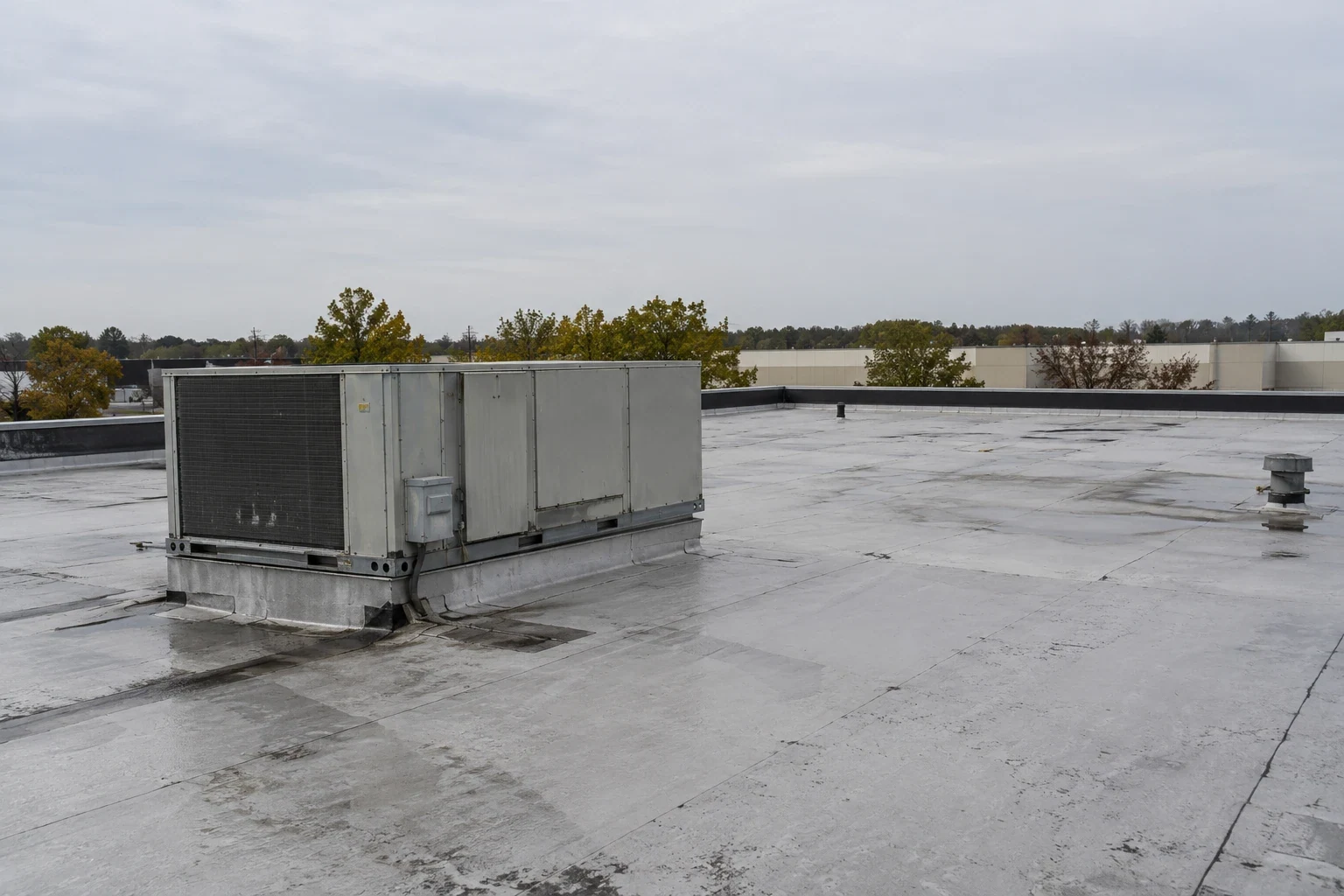
Fulfillment buildings carry rooftop units, exhaust fans, fire-protection risers, antennas and cable trays. Each is a penetration or a support, and each can leak or damage the roof if it moves. We check curbs, pipe supports and the pads under them for crushed insulation and torn membrane.

Maintenance traffic wears walk routes, and a dropped tool can puncture the sheet. We mark traffic paths, recommend pads where they are missing and log every puncture with a photograph. The register lists equipment by location so repairs are tied to the right unit. When a unit is replaced, the curb, flashing and wiring penetrations are inspected the same day, since an equipment swap is a common moment for roof damage, and the log shows who was on the roof and when.

Distribution Center Roofing

Tenant Schedules and Peak Season Planning

Prairie Highlands Corporate Park lies west of I-94 and has tenants including Haribo, Eli Lilly and Company, Aurora Healthcare and Uline. Parks of this kind mix users with different calendars, and roof work has to avoid each tenant's peak weeks. We ask for the peak calendar early and plan repairs and replacements around it.

Work windows are written into the scope with access, staging and protection of the floor below. If a leak appears in peak season, the response is stabilization and documentation, and the lasting repair is scheduled for the next quiet period. The log separates the two so the owner can see what has been finished.

Distribution Center Roofing

Moisture Surveys and Roof Replacement Planning

A leak that has run for a season can leave wet insulation across a wide area. A moisture survey and core cuts define the boundary, and the map becomes the basis for a replacement or partial replacement scope. On a large roof, the difference between a partial and a full replacement is a large share of the cost.

We price repair, recover and replacement against one scope. The warehouse roof file and the distribution file share the same format, so a portfolio owner can compare them directly. A manufacturing plant in the same portfolio follows the same format, with extra fields for process exhaust and heat.

Distribution Center Roofing

Closing the File for the Capital Request

At close-out we deliver the dated photo sets, the leak trace record, drain and ponding data, moisture maps and a condition rating. The condition report is written for a capital request, and the Pleasant Prairie and Kenosha buildings can sit in one register. The register also lists each building's roof access method and the contact who can release a dock lane for a crane, so a repeat visit starts with a name instead of a search.

Request a dated baseline inspection

Questions About Distribution Center Roofing

Why is a distribution center leak hard to locate?

Water travels along the deck and insulation before it drops, so the stain is often far from the opening. We map interior reports, trace likely paths and test suspect details. The trace goes into the log with the cause found and the repair made, and a repeat leak at the same spot is flagged for a deeper look.

How do we tell condensation from a leak at the dock edge?

By the pattern and the timing. Condensation forms on cold surfaces near open doors in winter and spreads across wide areas, while a leak follows a seam or a detail. A moisture survey settles close cases and keeps repairs aimed at the right cause.

Can roof work avoid peak season?

Planned work can, if we know the calendar early. Emergency leaks are stabilized and documented in peak weeks, and lasting repairs wait for the next quiet period. The scope states which items are temporary and which are final.

What should a facility director keep for each roof?

The roof plan, dated photographs, drain and ponding records, equipment locations, repair history and a condition rating. Those records support a capital request and guide the next inspection, whoever carries it out.

Does building size tell us how long the roof will last?

No. Size sets the scale of the work, not the condition of the membrane. Drainage, attachment, exposure and repair history decide it, and we rate each roof from its own record.

ServicesRoof SystemsIndustriesProperty TypesService AreasDamage RepairCapabilitiesManufacturersContactAboutRequest a Roof Assessment555-555-5555
Call555-555-5555